

Who Was Atticus in the Bible is a common question, but the name Atticus does not appear in the Bible. There is no biblical figure named Atticus mentioned in either the Old Testament or the New Testament. The name is best known from Roman history and later literature, rather than from Scripture.
Atticus is of Latin origin, meaning “from Attica” (a region in ancient Greece), and it became popular through historical and literary use, especially in Roman culture. While Atticus is not a biblical character, the values often associated with the name—such as wisdom, integrity, and moral strength—align with qualities encouraged throughout the Bible.
Who Was Atticus in the Bible?

Atticus is not a person mentioned in the Bible. The name does not appear in either the Old or New Testament. Atticus is a Latin/Roman name, meaning “from Attica” (a region in ancient Greece), and is best known today from literature—most famously Atticus Finch in To Kill a Mockingbird. Because of this, there is no biblical story, role, or character associated with the name Atticus.
The confusion likely arises because Atticus sounds similar to biblical names like Titus, Silas, or Aquila, shares the classical Greek-Roman naming style of many New Testament figures, and has been adopted by Christian families throughout history who appreciated its meaning of “from Attica” or its association with wisdom, learning, and noble character traits that align with biblical values.
The Historical Origin of the Name Atticus
The name Atticus originates from ancient Greece, specifically meaning “from Attica” or “of Athens,” the region surrounding the culturally and intellectually influential city-state of Athens known for philosophy, learning, and democratic governance. Originally used as a cognomen (surname or nickname) in Roman society to designate someone with Athenian connections, heritage, or characteristics associated with Athenian culture such as refinement, education, and cultural sophistication.
The name gained prominence through historical figures like Titus Pomponius Atticus (110-32 BC), a wealthy Roman philosopher, publisher, and patron of the arts who was renowned for his wisdom, neutrality in political conflicts, and friendship with Cicero, making Atticus synonymous with intellectual pursuit, diplomatic skill, and cultured living throughout the Roman world and subsequent Western civilization.
Atticus Herodes: The Biblical Era Figure
Atticus Herodes, more commonly known as Herodes Atticus (AD 101-177), was a prominent Greek aristocrat, sophist, and Roman senator who lived during the biblical era but is not mentioned in Scripture itself, despite his significant influence in the Roman Empire during the time early Christianity was spreading.
Born to immense wealth in Marathon, Greece, Herodes Atticus became famous for his extraordinary philanthropy, funding the construction of magnificent public buildings including the Odeon theater in Athens, aqueducts, stadiums, and temples throughout Greece and Rome.
While his lifetime overlapped with the apostolic fathers and second-generation Christians, there’s no historical record of direct interaction between Herodes Atticus and the Christian movement, though he certainly would have been aware of Christianity’s growing presence in the empire he served and the cities he beautified through his legendary generosity.
Atticus in Early Christian Literature

While the name Atticus doesn’t appear in canonical Scripture, it does surface in early Christian writings, church histories, and patristic literature from the centuries immediately following the apostolic age when Christianity was establishing itself throughout the Roman Empire. Early Christian authors occasionally referenced contemporary figures named Atticus, used the name in theological discussions, or mentioned individuals bearing this name in historical accounts of church controversies, councils, and leadership succession.
The most significant appearance of the name in Christian literature relates to Atticus of Constantinople, the Patriarch who played a crucial role in early church politics and theology, demonstrating that while not biblical, the name Atticus was present in Christian circles and carried respect within the growing Christian community of the late ancient world.
Atticus in Early Christian History
The name Atticus appears in early Christian history primarily through church leaders and theologians who bore this name during Christianity’s formative centuries when the faith was transitioning from persecuted minority to imperial religion. These early Christian figures named Atticus served in various capacities—bishops, theologians, administrators—during periods of significant theological controversy, doctrinal development, and ecclesiastical organization that shaped orthodox Christianity.
Their contributions to early church history, while perhaps not as celebrated as the apostles or major church fathers, nevertheless represent the countless faithful Christians who built the institutional church, preserved apostolic teaching, and passed the faith to subsequent generations during Christianity’s critical early development.
Saint Atticus of Constantinople
| Aspect | Details |
| Full Title | Saint Atticus of Constantinople, Patriarch of Constantinople |
| Years of Service | Patriarch from AD 406-425 (19 years) |
| Historical Context | Served during tumultuous period following John Chrysostom’s exile and death; worked to heal divisions in the Eastern Church |
| Major Achievements | Restored John Chrysostom’s name to the diptychs (official church records), bringing reconciliation between warring factions; strengthened Constantinople’s ecclesiastical authority; known for pastoral wisdom and diplomatic skill |
| Theological Contributions | Defended Nicene orthodoxy against Arianism; contributed to development of Christological doctrine; wrote theological letters and homilies |
| Character Qualities | Renowned for gentleness, wisdom, diplomacy, and ability to bring reconciliation between opposing parties; balanced firmness in doctrine with pastoral compassion |
| Legacy | Venerated as saint in Eastern Orthodox Church; feast day celebrated January 8; remembered as peacemaker who healed church divisions through wisdom rather than force |
| Death | Died October 10, AD 425 in Constantinople; succeeded by Sisinnius |
Saint Atticus of Constantinople (died AD 425) served as Patriarch of Constantinople from 406-425 during one of the most divisive periods in early church history, following the controversial exile and death of his predecessor John Chrysostom.
Known for his diplomatic skill and pastoral wisdom, Atticus successfully healed the schism that had torn the Eastern Church apart by restoring Chrysostom’s name to the church records while maintaining relationships with all factions.
His legacy as a peacemaker, defender of orthodoxy, and wise church leader earned him veneration as a saint in the Eastern Orthodox tradition, where his feast is celebrated on January 8, demonstrating that the name Atticus carries genuine Christian historical significance even though it doesn’t appear in Scripture.
Other Early Christian Figures Named Atticus
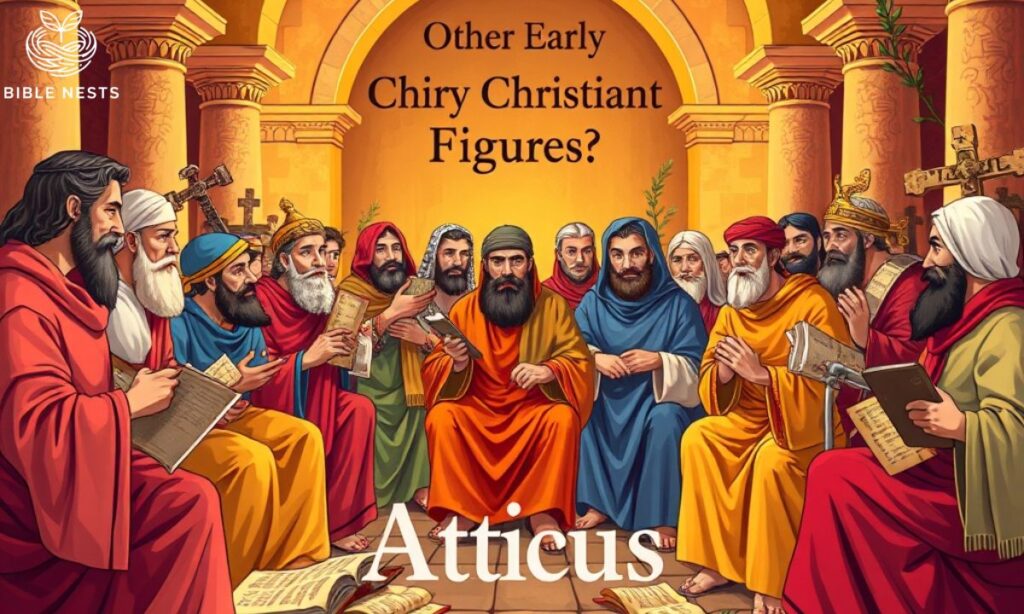
Beyond the famous Patriarch of Constantinople, several other individuals named Atticus appear in early Christian historical records, church documents, and regional histories from the patristic period through the early medieval era. These lesser-known bearers of the name served as bishops in various cities, theologians contributing to doctrinal discussions, martyrs who died for their faith during persecutions, and ordinary Christians whose names appear in church records, inscriptions, and correspondence.
While not achieving the prominence of Saint Atticus of Constantinople, these individuals demonstrate that the name enjoyed usage within Christian communities throughout the ancient world, carried by both clergy and laity who lived out their faith during Christianity’s formative centuries and contributed to the faith’s preservation and transmission.
The Meaning and Symbolism of Atticus
The name Atticus carries rich meaning and symbolism rooted in its Greek etymology “from Attica/Athens” which associates it with the cultural, intellectual, and philosophical heritage of classical Athens—the birthplace of Western philosophy, democracy, and rational inquiry. Beyond its geographical meaning, Atticus symbolizes qualities historically associated with Athenian culture: wisdom, learning, eloquence, cultural refinement, philosophical inquiry, and the pursuit of truth through reason and dialogue.
For Christians adopting this name, Atticus can symbolize the integration of classical learning with Christian faith, the pursuit of truth wherever it’s found, and the embodiment of virtues like wisdom, justice, courage, and temperance that both Greek philosophy and biblical teaching uphold—making it a name that bridges ancient wisdom traditions with Christian revelation.
Wisdom and Learning
Atticus symbolizes wisdom and learning because of its association with Athens, the ancient world’s intellectual capital where Socrates, Plato, and Aristotle developed philosophical systems that shaped Western thought for millennia. The name evokes images of the Academy, the Lyceum, the Stoa—institutions of higher learning where truth was pursued through rigorous inquiry, debate, and contemplation.
For Christians, choosing the name Atticus can represent a commitment to developing the mind God has given, pursuing wisdom as Proverbs commands, and recognizing that “all truth is God’s truth” whether discovered through Scripture, nature, reason, or human inquiry—embodying the biblical principle that loving God includes loving Him with all your mind.
Integrity and Honor
The name Atticus became synonymous with integrity and honor through historical figures like Titus Pomponius Atticus, who was renowned for maintaining friendships across political divides, refusing to compromise his principles for power, and living with consistent ethical standards that earned universal respect. This association makes Atticus symbolize moral courage, principled living, and the refusal to sacrifice integrity for convenience or advancement.
For Christians, these qualities align perfectly with biblical commands to walk with integrity (Proverbs 10:9), let your yes be yes and your no be no (Matthew 5:37), and maintain good character that brings glory to God—making Atticus a name that calls its bearer to live honorably in all circumstances.
Diplomatic Reconciliation
Atticus symbolizes diplomatic reconciliation primarily through Saint Atticus of Constantinople, who healed devastating church divisions through wisdom, patience, and the ability to bring opposing factions together without compromising essential truth. This reconciling quality reflects the biblical calling to be peacemakers (Matthew 5:9), to live at peace with everyone as far as it depends on you (Romans 12:18), and to pursue the unity of the Spirit in the bond of peace (Ephesians 4:3).
The Legacy of Atticus
The legacy of Atticus spans multiple dimensions—classical intellectual heritage through figures like Titus Pomponius Atticus, early Christian ecclesiastical leadership through Saint Atticus of Constantinople, and modern literary influence through characters like Atticus Finch in “To Kill a Mockingbird” who embodied justice, integrity, and moral courage.
This multi-layered legacy makes Atticus a name that connects ancient wisdom with Christian virtue and contemporary values, representing the enduring human aspiration toward knowledge, righteousness, and principled living across different eras and cultures.
For Christians today, the legacy of Atticus provides a rich heritage that honors both the life of the mind and the integrity of character, demonstrating that faith and reason, classical learning and Christian commitment, ancient wisdom and timeless truth can be integrated in lives that honor God and serve humanity.
Why People Think Atticus Is Biblical

Many people mistakenly assume Atticus is a biblical name because it shares the classical Greek-Roman phonetic style, the characteristic “-us” ending, and the authoritative ancient sound of authentic New Testament names like Titus, Silas, Matthias, and Aquila
The Sound and Style
People often assume Atticus is biblical because it shares the phonetic style, rhythm, and classical sound of authentic New Testament names like Titus, Silas, Matthias, Aquila, and Barnabas—all Greek or Latin names of early Christians. The “-us” ending is characteristic of Latinized Greek names common in the New Testament era, creating linguistic familiarity that makes Atticus feel like it belongs in the same category as Pauline companions and early church leaders.
Additionally, the two-syllable structure and strong consonant sounds give Atticus the same authoritative, ancient quality as biblical names, making it easily mistaken for a scriptural name by those not deeply familiar with the actual biblical text.
Literary Influence
The modern perception of Atticus as a biblical or Christian name has been significantly shaped by Harper Lee’s “To Kill a Mockingbird,” where Atticus Finch embodies Christ-like qualities of justice, mercy, moral courage, and sacrificial love for others regardless of personal cost. This literary character’s association with biblical values—defending the innocent, standing against injustice, teaching children righteousness, and demonstrating integrity under pressure—has created a powerful cultural connection between the name Atticus and Christian virtue.
Use in Christian Communities
Atticus has been used within Christian communities for centuries, particularly in Eastern Orthodox traditions that venerate Saint Atticus of Constantinople, and among Western Christians who appreciated its classical heritage and virtuous associations. This longstanding usage within the church has created the impression that Atticus must be biblical, as many Christians assume that traditional Christian names originate in Scripture.
Biblical Names Similar to Atticus
Several authentic biblical names share Atticus’s classical Greek-Roman sound, sophisticated style, and strong character associations, making them excellent alternatives for parents who love Atticus but prefer a name explicitly found in Scripture.
Titus
Titus is an authentic New Testament name belonging to a trusted companion of Paul who became a church leader in Crete and recipient of one of Paul’s pastoral epistles (the Book of Titus). Like Atticus, Titus is a Latin/Greek name with a strong, classical sound ending in “-us,” making the two names phonetically similar.
Titus means “honorable” or “of the giants,” and the biblical Titus exemplified leadership, faithfulness, and pastoral care—qualities that align with the virtuous associations of Atticus, making Titus an excellent biblical alternative for parents who love the sound and feel of Atticus but want a name that actually appears in Scripture.
Silas
Silas (also called Silvanus) was a leading prophet in the early church who accompanied Paul on his second missionary journey, co-authored several New Testament letters, and demonstrated courage, faithfulness, and ministry gifting throughout Acts and the epistles. The name shares Atticus’s classical sound, ancient heritage, and association with wisdom and leadership in the early Christian movement.
Silas means “wood” or “forest” in Latin, or possibly “asked for” from Hebrew origins, and like Atticus, it’s a strong, distinctive name with historical depth that appeals to parents wanting a name rooted in early Christianity with a timeless, sophisticated sound.
Aquila
Aquila was a Jewish-Christian tentmaker, missionary, and teacher who, along with his wife Priscilla, hosted house churches, instructed Apollos in sound doctrine, and worked closely with Paul throughout his ministry journeys (mentioned in Acts, Romans, and Corinthians). The name Aquila means “eagle” in Latin and shares with Atticus the classical Latin style, the elegant two-to-three syllable structure, and the association with strength, nobility, and Christian leadership.
Aquila represents the integration of Jewish heritage with Greco-Roman culture in early Christianity—a bridging quality similar to how Atticus bridges classical learning with Christian values, making it an excellent biblical alternative with similar appeal.
Matthias
Matthias was chosen by the apostles to replace Judas Iscariot, becoming the twelfth apostle and witness to Jesus’ resurrection (Acts 1:23-26). The name Matthias is Greek, meaning “gift of God,” and shares with Atticus the multi-syllabic classical sound, the “-as” ending common in Greek names, and the historical gravitas associated with early church leadership.
Matthias represents faithful service, divine selection, and apostolic calling—qualities that resonate with the virtuous character associations of Atticus, making it a biblically-grounded option for parents drawn to Atticus’s sound and feel but wanting a name with direct scriptural presence.
Barnabas
Barnabas, whose given name was Joseph, received this apostolic nickname meaning “son of encouragement” because of his generous, encouraging character that strengthened the early church through financial support, missionary partnership with Paul, and mentoring of John Mark. The name Barnabas shares with Atticus the three-syllable structure, the classical Greco-Roman sound, and strong associations with wisdom, generosity, and Christian leadership.
Barnabas represents encouragement, reconciliation (he restored Mark after his failure), and grace-filled mentorship—qualities parallel to the diplomatic reconciliation associated with Saint Atticus of Constantinople, making Barnabas an excellent biblical alternative with similar character connotations.
Using Atticus as a Christian Name Today

Atticus has become increasingly popular among Christian families today who appreciate its rich historical heritage, virtuous character associations, and the perfect balance it strikes between classical sophistication and contemporary appeal without being explicitly biblical.
Historical Christian Heritage
Using Atticus as a Christian name today honors genuine Christian heritage through Saint Atticus of Constantinople and other early church figures who bore this name faithfully, demonstrating that while not biblical, Atticus has authentic roots in Christian history spanning over 1,600 years. Parents choosing Atticus connect their child to the legacy of church fathers who defended orthodoxy, healed divisions, and served Christ during Christianity’s formative centuries.
Virtue-Based Meaning
Atticus works beautifully as a Christian name because its meaning and associations align perfectly with biblical virtues—wisdom (James 1:5), learning (Proverbs 1:5), integrity (Proverbs 10:9), honor (Romans 12:10), diplomacy (Matthew 5:9), and the pursuit of truth (John 8:32). Naming a child Atticus can serve as a daily reminder and prayer that they will develop these Christ-like qualities throughout their life.
Cultural Bridge
Atticus serves as a cultural bridge name that connects Christian faith with broader cultural literacy, classical education, and literary heritage—particularly through “To Kill a Mockingbird”—making it appealing in secular contexts while maintaining Christian virtue associations.
Distinctive but Recognizable
The name is recognizable through literary and historical references, easy to spell and pronounce, ages well from childhood through adulthood, and carries gravitas appropriate for professional contexts while remaining approachable. This combination makes Atticus practical for real-world use while still feeling special and meaningful, avoiding both the blandness of overly common names and the burden of extremely unusual names that can disadvantage children socially and professionally.
The Name Atticus in Ancient Greek and Roman Society
In Roman society, Atticus became a respected personal name and surname, often used to show admiration for Greek culture. One of the most famous figures was Titus Pomponius Atticus, a Roman scholar and close friend of Cicero, known for his wisdom, neutrality in politics, and cultured lifestyle. Over time, the name Atticus came to symbolize intellect, moral character, and cultural prestige in both Greek and Roman traditions
Social Status and Meaning
In ancient Greek and Roman society, the name Atticus carried connotations of high social status, cultural refinement, education, and connection to Athens—the intellectual and cultural capital of the classical world admired even by Romans who conquered it militarily. Being called Atticus suggested Athenian heritage or characteristics, implying the bearer possessed Greek paideia (cultural education), philosophical sophistication, appreciation for arts and literature, and the urbane refinement associated with Greek civilization’s highest achievements.
Notable Bearers of the Name
The most famous bearer was Titus Pomponius Atticus (110-32 BC), wealthy Roman equestrian, publisher, philosopher, and patron of arts who exemplified the name’s associations with learning, wisdom, and refined character—his vast library, publication business, and friendships with leading intellectuals like Cicero made him legendary.
Frequently Asked Questions
Who was Atticus in the Bible?
There is no person named Atticus mentioned in the Bible.
Is Atticus a biblical name?
No, Atticus is not a biblical name found in Scripture.
Why do people think Atticus is in the Bible?
The name is often confused with similar-sounding biblical names or later historical figures.
Is Atticus mentioned in the New Testament?
No, Atticus does not appear in the New Testament.
Is Atticus a Roman name?
Yes, Atticus is a Roman name, meaning “from Attica” (a region in Greece).
Is Atticus related to any biblical character?
No direct connection exists between Atticus and any biblical人物.
What biblical names are similar to Atticus?
Names like Tychicus or Atticus-sounding Greek names are sometimes confused with it.
Can Atticus still be a Christian name?
Yes, many Christians use Atticus even though it’s not found in the Bible.
Does the name Atticus have spiritual meaning?
While not biblical, it can symbolize wisdom, learning, and character.
Is it okay to choose a non-biblical name like Atticus?
Yes, many faithful believers choose names with positive meanings, even if not in Scripture.
Conclusion
Although Atticus is not a biblical figure, the values often associated with the name—such as integrity, wisdom, justice, and moral courage—closely reflect biblical principles. Scripture frequently highlights these virtues through many biblical characters, even if the name itself is absent.
For those exploring Atticus from a faith perspective, the name can still carry symbolic meaning aligned with biblical teachings. While not found in the Bible, it can represent a life committed to righteousness, fairness, and strong character—qualities deeply rooted in Scripture.

Denzel is a passionate Christian writer with 4 years of experience in Bible and prayer blogging. He is currently sharing his inspiring spiritual writings on BibleNests.com, helping readers grow in faith and hope.
